
High-Yield Savings Accounts Explained (And Why Yours Might Be Costing You)
If your savings are sitting in a standard account earning almost nothing, you could be quietly losing money to inflation. Here's what a high-yield savings account is and how to choose one.
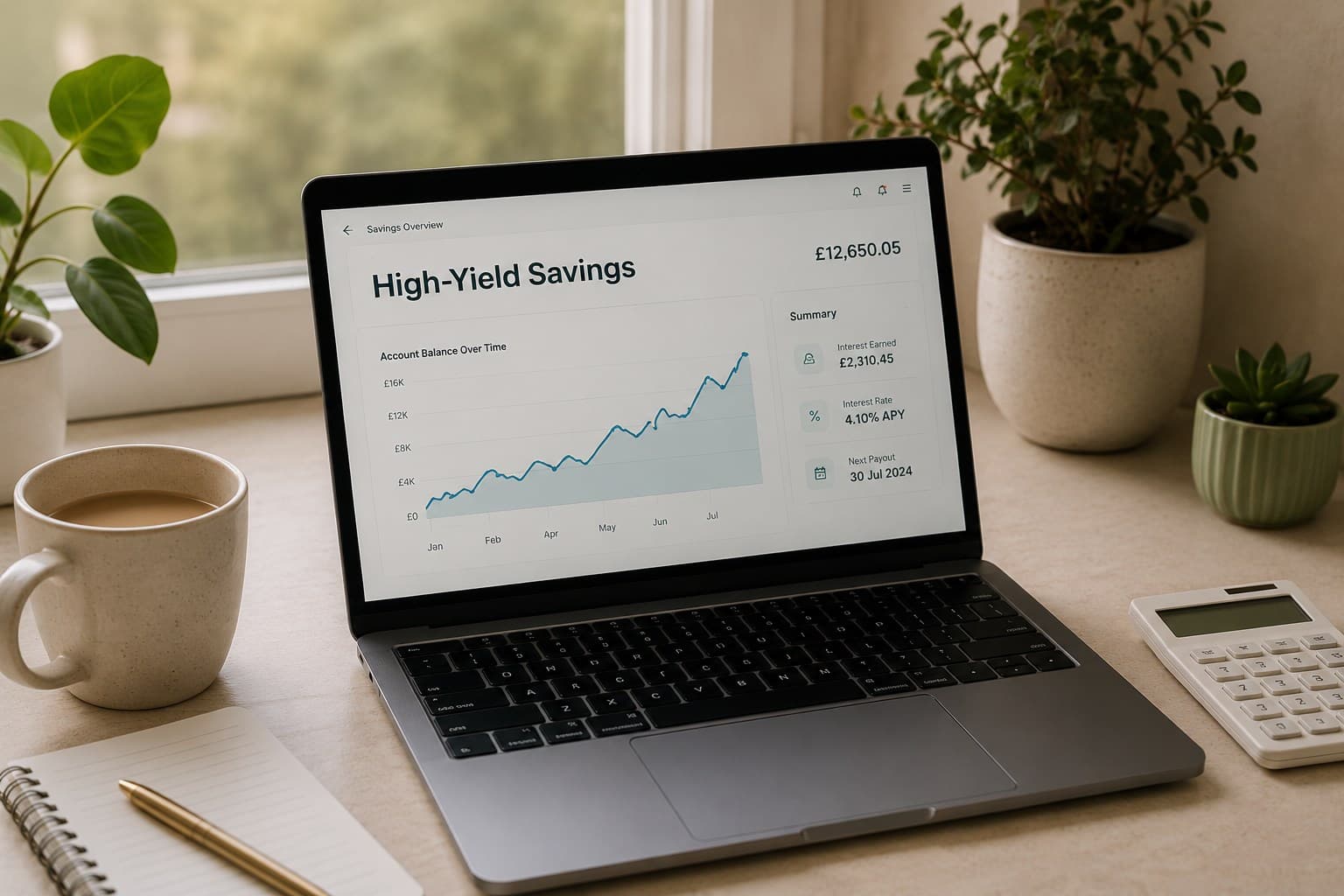
If your savings have been sitting in the same account for years without you checking the interest rate, there's a good chance you're quietly losing value to inflation without realising it.
A high-yield savings account pays meaningfully more interest than a standard savings or current account, while still keeping your money easily accessible. For money you're not investing, like an emergency fund, it's usually the better home for your cash.
What is a high-yield savings account?
"High-yield" isn't a special type of account or an official product name. It simply describes any savings account that pays a much higher interest rate than a typical standard account.
The difference from a normal savings account is mostly the rate. A standard savings account, especially the default one attached to a high-street current account, often pays close to nothing. A high-yield account pays meaningfully more, while working in exactly the same way: you deposit money, it earns interest, and it stays protected by your country's deposit protection scheme (the FSCS in the UK). Some high-yield accounts are online-only, or ask you to keep a minimum balance or limit withdrawals in return for the better rate.
Where to find them: the most competitive rates usually come from online and app-based banks, building societies, and savings platforms (marketplaces that let you open accounts with several providers in one place), rather than the big high-street banks. Free comparison sites list current top rates, and because rates change often, it is worth comparing live rather than assuming your existing account is still competitive.
Why the interest rate on your savings account actually matters
Inflation quietly reduces the purchasing power of cash sitting still. If your savings account pays close to 0% interest while inflation runs at 3%, your money is effectively losing value every year, even though the number on the screen hasn't changed.
A high-yield savings account won't make you rich, but it meaningfully slows, or in good conditions, offsets, that quiet erosion, for money you need to keep safe and accessible rather than invest.
Example
£10,000 sitting in an account paying 0.1% interest earns you around £10 in a year. The same £10,000 in an account paying a competitive high-yield rate could earn several hundred pounds instead, for the exact same level of safety and accessibility.
What to look for in a high-yield savings account
| Feature | Why it matters |
|---|---|
| Competitive interest rate | The higher rate is the whole point of the account. Rates change often, so compare current rates rather than the one you opened with. |
| Easy access | Your emergency fund needs to be reachable within a day or two, not locked away. |
| No or low minimum balance | Avoid accounts that penalise you for saving smaller amounts while you build up your fund. |
| Regulated institution | Confirm your money is protected under your country's deposit protection scheme (the FSCS in the UK). |
| No unnecessary fees | Some accounts quietly charge maintenance fees that eat into the extra interest earned. |
Easy access vs fixed-term accounts
One thing that trips people up: "high-yield" describes the interest rate, while "easy-access", "fixed-term" and "notice" describe how you can get to your money. They are two separate things. A fixed-term account can pay a high yield too, so the access type matters just as much as the rate:
- Easy-access accounts let you withdraw anytime, usually within a day or two, ideal for an emergency fund.
- Fixed-term or notice accounts often pay an even higher rate in exchange for locking your money away for a set period, or requiring notice before you withdraw. They can be high-yield, but they are better suited to money you know you won't need soon, not your emergency fund.
For an emergency fund specifically, accessibility should always come before chasing an extra fraction of a percent in interest. A high rate is no good if you can't reach the money when an emergency actually happens.
How to actually make the switch
- Check the current interest rate on your existing savings account.
- Compare it against a few high-yield options from regulated banks or building societies.
- Confirm withdrawal terms, make sure "high-yield" doesn't come with hidden restrictions that compromise accessibility.
- Transfer your emergency fund and any sinking funds once you're confident in the new account's terms.
Common mistakes
- Never checking the rate again after opening an account. Rates change, a competitive account two years ago may not be competitive today.
- Chasing the highest rate at the cost of accessibility. A slightly lower rate with same-day access is usually better for an emergency fund than a higher rate with a lock-up period.
- Assuming all savings accounts are basically the same. The difference between accounts can be significant over a year.
Key takeaways
- Standard savings accounts often pay close to nothing, quietly losing value to inflation over time.
- A high-yield savings account keeps your money safe and accessible while earning meaningfully more interest.
- Prioritise easy access over the absolute highest rate for money like an emergency fund.
- Revisit your account's interest rate periodically, competitive rates change over time.
Once your cash savings are working properly, you're ready for the next stage of the journey: understanding how investing actually works, and how it's different from saving.
The Personal Finance Guide
The complete, step-by-step system for understanding your money.
A calm, step-by-step walkthrough of exactly how to organise your money, from your first budget to your first investment, explained simply and without the jargon.
Related articles
The Complete Emergency Fund Guide: How Much to Save and Where to Keep It
How much should your emergency fund actually be, and where should you keep it? A clear, step-by-step guide to building your financial safety net.
Sinking Funds Explained: The Saving Strategy That Stops Surprise Expenses
Sinking funds are the simplest way to stop 'unexpected' expenses from wrecking your budget. Here's exactly what they are and how to set them up.

Investing for Complete Beginners: How to Start With Confidence
Never invested before? Here's a clear, plain-English introduction to what investing actually is, why it matters, and exactly how to take your first step.